

Dear Sisters and members of the Family of Incarnation :
This November, COP 30 will be held in Belém, Brazil. The Conferences of the Parties (COP) are high-level conferences organized by the United Nations that bring together States, regional organizations, and non-state actors. They are convened annually at the end of the year to adopt binding decisions to curb climate change
Ten years ago, Laudato Si’ was published, which undoubtedly influenced the decision of 196 countries to sign the Paris Agreement at COP 21 in December 2015, committing themselves to limiting the global average temperature increase to below 2°C above pre-industrial levels and to intensifying the actions and investments necessary for a sustainable, carbon-free future. Unfortunately, the Paris Agreement has not been implemented.
Since 2023, the Vatican has participated in COPs as a full member, rather than merely as an observer.
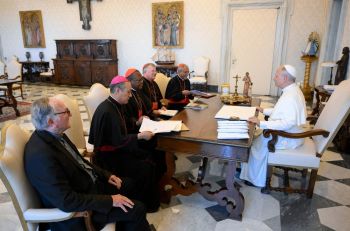
major new development this year is the contribution of regional bishops’ conferences and councils from Africa and Madagascar (SECAM), the Federation of Asian Bishops’ Conferences (FABC), and the Latin American Episcopal Council (CELAM), which, coordinated by the Pontifical Commission for Latin America (PCAL), in preparation for the Summit, have published the document “A Call for Climate Justice and the Common Home : Ecological Conversion, Transformation, and Resistance to False Solutions.”
The bishops declare that “as missionary apostles of a synodal Church reaching out, we will go to COP 30 to build that peace in the midst of this piecemeal war against creation, where many are dying and many more will die if we do not act now, as UN scientists warn.”
The document is the result of a synodal process, of spiritual and communal discernment among the sister Churches of the Global South. Its message is clear : “there is no climate justice without ecological conversion, and there is no ecological conversion without resistance to false solutions.”
They denounce the financialization of nature, which turns the vital elements of creation, such as forests, rivers, and climates, into negotiable financial assets ; in other words, nature is given a price tag and then traded like any other commodity according to market rules among those who have access to it.
Among the false solutions, they reject the carbon offset mechanism (the process of offsetting greenhouse gas emissions by financing projects that prevent the emission of an equivalent amount of carbon dioxide, CO₂, elsewhere), as it unduly transfers the burden of reducing emissions from those who cause them to those who suffer from them.
They remind us that every new investment in oil, gas, or coal exacerbates the climate emergency. And they demand recognition of migration due to climate change (desertification already affects 500 million people).
From the region hosting COP 30, the Church offers to educate on integral ecology, accompany suffering communities, and create the Ecclesial Observatory on Climate Justice, promoted by the Ecclesial Conference of the Amazon (CEAMA), to monitor COP commitments and their fulfillment in the Global South, as well as to denounce unfulfilled commitments.
For the Churches of the South, this document is a practical application of Laudato Si’ ten years after its publication. They conclude : “Our current decisions impact future generations ; we advocate for intergenerational justice that ensures a habitable and prosperous planet for all forms of life.”
For our part, as the Ursulines of Jesus Congregation, we have joined the petition issued by the International Union of Superiors General (UISG), which we reproduce below.
1. Cancel the debts of poor countries, as unfair and unpayable debts should not compromise resources for climate change adaptation and mitigation efforts.
2. Strengthen the Loss and Damage Fund (LDF) by allocating sufficient resources to address the serious effects of climate change.
3. Establish goals for a just energy transition that aims to reduce CO2 emissions, consider historical responsibilities, respect human rights—especially those of indigenous peoples—values and cares for nature, and prioritize sustainable livelihoods over purely profit-driven models.
4. Establish clear objectives for developing a global food system based on food sovereignty and agroecological practices, promoting culturally adapted methods of food production, processing, distribution and consumption.
Let us join together in prayer between November 10 and 21, the days of COP 30 in Belém, so that effective steps may be taken in the commitment to implement the Paris Agreements.
With affection Marie Thérère Bonnet and Mariángel Marco International Commission for Integral Ecology UdJ November 1, 2025
