

We welcome you with this linguistic diversity to this exchange page.
February 21st is International Mother Language Day.
« Our mother tongues, a cultural treasure and the foundation of our identity »
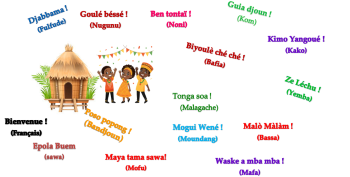
The land of Cameroon is rich in cultural and linguistic diversity; the coexisting mother tongues form a mosaic. There are approximately 268 languages spoken within Cameroonian territory. These include Ewondo, Nugunu, Mofou, Fulfulde, Yemba, Mafa, Moundang, Kako, Bulu, Ghomala, and Sawa, to name just a few.
By mother tongue, we mean the first language a child learns. It is the first language through which the child learns to communicate with those around them.
Mother tongue is defined as that through which a human being learns about life through their parents, siblings, and various educators.
A cultural treasure
Mother tongues represent the living memory of our cultures; they are the main means of transmitting cultural heritage (traditions, values, customs, etc.).
Our languages are a means of communication that creates a closeness between people. This is the case for our Ursuline Sisters of Jesus who are sent on mission to other regions of the country, different from their own; they have the duty to learn the local languages in order to work in the pastoral field (education, health, etc.).
The contribution of our native languages
Speaking in one’s native language opens up a number of advantages such as: • Strengthening or consolidating family and social ties. • Facilitating the learning of other languages. • Supporting the cognitive and social development of each individual. • A means of communication and socialization for positive interaction between people. • Acquisition of basic skills such as writing, reading, and even arithmetic.
A cultural identity

Speaking one’s mother tongue strengthens the sense of belonging to a community or ethnic group. The mother tongue allows each individual to integrate well into their community and specific culture.
In the transmission of cultures, it promotes this sharing of customs and cultural values for better assimilation.
Our native languages contribute to the construction of our identity. The ability to integrate all the languages we speak is an inherent richness, in that it allows us to make choices, to vary and nuance our ideas and thoughts.
People who are well-grounded in their language find it easier to establish reference points and are more open to the outside world. Thus, we can see that languages constitute a true wealth.
The loss of our native languages
? Globalization and urbanization We are increasingly observing that younger generations are no longer interested in learning their mother tongues. This decline is attributed to globalization and urbanization; these factors act as a barrier to the transmission of this living memory, a barrier to the preservation of our cultural heritage.
? Intertribal struggles The Cameroonian landscape demonstrates a social cohesion that still needs improvement due to ongoing conflicts between certain tribes.
« Hope does not disappoint » Rm 5,5.
Beyond all these difficulties, our cultural diversity compels us to promote “living together” and to continue transmitting our mother tongues to future generations, as they occupy an undeniable place not only in learning and our cultural identity, but also in the entirety of a person’s life. We are therefore called upon to preserve and revitalize our mother tongues. They constitute a cultural treasure, the foundation of our identity and the enrichment of our human diversity.
It is in this linguistic plurality that we, the Ursuline Sisters of Jesus of the Missionary Reality of Cameroon, want to be women of the covenant, prophets of communion in social cohesion and pilgrims of hope.
