

Dear sisters and Family of Incarnation :
Once again, we are reaching out to each community, to each one of you, in a healthy attempt to spark interest and raise awareness about the importance of large-scale, long-term changes in the planet’s climate system and their serious ecological consequences, which are causing massive population displacement.
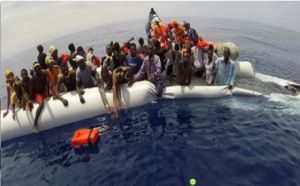
We would like to share a reflection and a deep feeling about the immense and complex world of migration, a phenomenon that overwhelms us in its entirety, and that is why we have chosen to place it in a smaller, more understandable and, above all, more vital space : that of the experience in Spain. And we do so from the vibrant reality of our communities.
Due to its geography, Spain is a strategic point on the migration map, a crossroads. Its location as the southern border of the European Union, a gateway to Africa via the Mediterranean and land routes, makes it a key passageway.
Added to this are the historic routes from Asia and the flow that, since the opening of the Atlantic sea routes, connects with the American continent. Today, this flow continues, although air travel from America predominates. This reality of constant transit and reception reminds us that human mobility is inseparable from the history of our land.
When we perceive the world as an interconnected system, where the relationships between living beings and their physical environment are fundamental to survival, it becomes urgent to reflect on our view of the human migrations that this causes.
Climate change intensifies droughts, floods and soil degradation, especially in North Africa and the Sahel, forcing many people to abandon their land due to lack of resources. Unsustainable exploitation of resources and socio-environmental and political conflicts also act as drivers of this forced migration. These ‘climate migrants’ are forced to move, with Spain as one of their main gateways to Europe.
We recognize that the global production and consumption model is the main source of degradation.
Solutions include migration policies with sustainability objectives and urban and rural planning that manages population growth without compromising local ecosystems. The migrant population in Spain integrates into consumption patterns and is concentrated in key sectors for land and resource use (agriculture, construction, hospitality), linking directly to land and water management.
This calls on us to fulfil a dual responsibility : to welcome migrants and, at the same time, to promote a sustainable way of life for all.
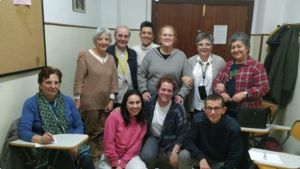
Our commitment : Support and advocacy based on real life experiences. As a congregation and as a Reality of Spain, we are no strangers to this migratory movement, whether for ecological, economic, political or security reasons. In many of our communities, there are sisters involved in the day-to-day work of welcoming new arrivals : teaching Spanish, providing educational support, accompanying families and helping with paperwork, through institutions and associations such as CÁRITAS, BERAKA, PUENTE DE ESPERANZA o ACOGE.
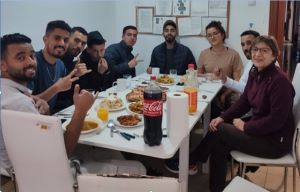
A living example of this commitment is the community of Roquetas de Mar, founded to care for the immigrant population and located in an area with high migration flows, especially from Africa.
Together with another congregation and, starting this year, with the Jesuits, its fundamental purpose is to accompany those who arrive to work in the greenhouses (‘sea of plastic’) : finding accommodation, providing food, helping with regularization and offering support workshops.
Our task is arduous and resources are always insufficient. Our main occupation and concern is to accompany and facilitate integration, working with both the arriving population and the local population to facilitate the welcoming and acceptance of diversity. Alongside our direct work, we remain steadfast in our efforts to denounce poor welcoming and laws that hinder entry, work and decent housing.
We participate in civil society spaces, such as the Circles of Silence, raising our voices for justice.
This work enlivens our spirituality. Beyond the practical, these spaces are true ENCOUNTERS in cultural diversity. We offer a small grain of sand, but with immense gratitude, we recognize that what we receive from this exchange of experiences is much more : it helps us to live a more incarnated solidarity and a more real communion.
We all feel called, wherever we are, to continue praying and getting involved in this vital challenge that surrounds us on all sides.
From Spain, a country that welcomes migrants, International Commission on Ecology
